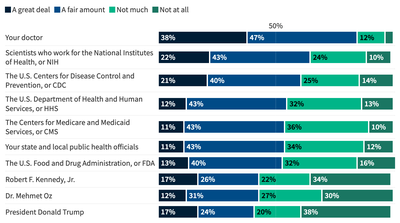
I’ve always found the work coming out of the Kaiser Family Foundation (KFF) to be unusually clear-eyed. Their tracking polls don’t just report numbers. They tend to capture how people are actually navigating health in everyday life. The latest survey on health information and trust is a good example. On the surface, it’s about where people get their information. But reading through it, it starts to feel like a story about something deeper: how people decide what to believe when it comes to their own well-being.
Most conversations about digital tools and mental health tend to focus on effectiveness, what works, what doesn’t, and how these tools compare to traditional care. But underneath those questions sits a quieter one: who people trust when they are trying to make sense of their mental health in the first place.
The KFF poll suggests that trust has not disappeared, but it has shifted. Personal doctors still rank as the most trusted source of health information, though even that trust has softened somewhat over time. Beyond that, things become less stable. Trust in public health institutions remains present, but uneven and increasingly shaped by political and social identity.
That unevenness matters for mental health in ways that are easy to overlook.
Mental health support, more than many other areas of care, often begins with interpretation. Is what I’m feeling serious enough to seek help? Is this stress, burnout, anxiety, or something else entirely? These are not questions people answer in isolation. They rely on information, cues, and sources they consider credible.
When trust becomes fragmented, so does that process.
For some, a licensed provider remains the primary reference point. For others, health agencies, online platforms, or even social networks may play a larger role. And increasingly, these sources do not always align with one another. The result is not simply confusion, but divergence: people navigating similar symptoms can arrive at very different conclusions depending on whom they trust.
This helps explain why access alone does not fully account for patterns in mental health help-seeking. Even when services are available, decisions about whether to use them are filtered through trust. If a person is skeptical of institutions, they may be less likely to engage with formal care. If they place more trust in peer networks or digital tools, they may turn to those instead.
In that sense, the growth of alternative mental health supports, including AI-based tools, can be read not only as a story of technological innovation but also as a response to gaps in trust.
The KFF findings reinforce this idea in a subtle way. They show that people are still actively engaging with health information, but they are doing so selectively. Trust is not vanishing; it is being redistributed across different sources, often along lines that extend beyond health itself.
For mental health, this raises a slightly different set of questions than the usual “does it work?” framing. It shifts the focus toward how individuals decide what counts as legitimate support, and how those decisions are shaped by broader social dynamics.
Mental health, in this light, is not only about symptoms or treatment. It is also about interpretation, and interpretation, increasingly, depends on trust.
Source: KFF Tracking Poll on Health Information and Trust (January 2025)