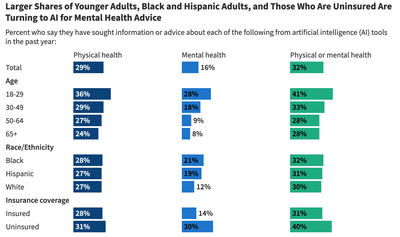
I found another interesting insight from Kaiser Family Foundation (KFF). Their recent tracking poll examines how people in the United States are using AI for health information and advice. What stands out is not simply that people are using these tools, but who is using them and under what conditions.
A meaningful share of adults report turning to AI for health-related purposes. However, this usage is not evenly distributed across the population. It tends to be more common among younger individuals, those with lower income, and those who face greater barriers when trying to access traditional healthcare. This pattern suggests that the use of AI is not only driven by curiosity or openness to new technology. It is also shaped by structural constraints that limit access to conventional forms of care.
Much of the public conversation around AI in mental health focuses on whether these tools are effective or whether they can replicate aspects of therapy. While those questions are important, the KFF data points to a different starting point. People are not necessarily turning to AI because it is better than existing options. They are often turning to it because it is immediately available, requires no scheduling, and does not involve the financial or logistical barriers associated with formal care.
Seen in this light, the rise of AI in health contexts reflects a broader pattern rather than a purely technological shift. When access to formal systems is constrained, people consistently seek alternative sources of support. AI becomes one more option within that landscape. At the same time, its availability can obscure underlying gaps in care infrastructure. If individuals are able to obtain some form of guidance or support, the absence of accessible, high-quality human care may become less visible.
For mental health, this has important implications. AI tools may lower the threshold for seeking help and provide a form of support that is immediate and low cost. They may also serve as an entry point for individuals who might otherwise not engage with mental health services at all. At the same time, reliance on AI may mirror existing inequalities. Those with fewer resources may be more likely to depend on AI rather than having access to a broader range of care options. Over time, this could contribute to differences not only in access, but in the nature and quality of support that people receive.
The KFF findings do not resolve the question of whether AI is beneficial or harmful for mental health. Instead, they highlight the conditions under which people make decisions about care. The increasing role of AI appears less as a replacement for existing systems and more as a response to their limitations.
Source: Kaiser Family Foundation. KFF Tracking Poll on Health Information and Trust: Use of AI for Health Information and Advice.